The Philippines is an archipelago of more than 7,600 islands, and its landmarks split into two families. One is built, Spanish-era walled cities, stone churches and heritage streets from three centuries of colonial rule. The other is volcanic, perfect cones, crater lakes, cave rivers and rice terraces carved into mountain walls. Seven of the eleven here are UNESCO sites, or part of one.
This guide lists the eleven that matter most on a first trip, with what each one costs, how to reach it and where it falls short. Prices are in pesos, written as ₱. Two of the landmarks are active volcanoes, so check the PHIVOLCS alert level for Mayon and Taal before any trip.
At a glance
| No. | Landmark | Where | Best for | Known for |
|---|---|---|---|---|
| 1 | Intramuros and Fort Santiago | Manila | History | The Spanish walled city and the fort where Rizal was held |
| 2 | Magellan’s Cross, the Basilica and Fort San Pedro | Cebu City | History and faith | The cross of 1521 and the oldest church in the country |
| 3 | Vigan and Calle Crisologo | Ilocos Sur, Luzon | A heritage walk | A colonial street of stone houses and kalesa carriages |
| 4 | Banaue and Batad Rice Terraces | Ifugao, Luzon | Mountain scenery | An amphitheatre of terraces about 2,000 years old |
| 5 | Mayon Volcano and the Cagsawa Ruins | Albay, Luzon | The classic volcano view | A near-perfect cone above a buried church tower |
| 6 | Taal Volcano and Tagaytay | Batangas, Luzon | An easy day trip | A volcano island inside a lake, seen from a ridge |
| 7 | Mount Pinatubo Crater Lake | Zambales and Tarlac, Luzon | Adventure | The turquoise lake left by the 1991 eruption |
| 8 | Chocolate Hills and the Tarsier Sanctuary | Bohol | Nature | More than 1,200 grass cones and a tiny primate |
| 9 | Puerto Princesa Underground River | Palawan | A natural wonder | A river running 8.2 km under a mountain |
| 10 | El Nido and the Bacuit Bay Lagoons | Palawan | Island scenery | Limestone lagoons reached on set boat tours |
| 11 | Tubbataha Reefs | Sulu Sea | Diving | A remote marine park open three months a year |
1. Intramuros and Fort Santiago

Intramuros is the walled city the Spanish built from 1571 as the centre of their colony, on the south bank of the Pasig River in Manila. Inside the walls, which run for about 4.5 km, stand the Manila Cathedral, the San Agustin Church of 1607, the oldest stone church in the country and a UNESCO site, and streets of museums and courtyard houses.
At the northwest corner stands Fort Santiago, the citadel that guarded the river mouth. The national hero José Rizal was imprisoned here before his execution in 1896, and bronze footsteps trace his last walk to the execution ground in what is now Rizal Park.
Cost: Walking the streets is free. Fort Santiago costs ₱75 for adults and ₱50 for students, senior citizens and persons with disabilities, and the San Agustin Museum costs about ₱200.
Opening hours: Fort Santiago opens Monday to Friday from 8 AM to 10 PM, and on weekends from 6 AM to 10 PM, with the last entry earlier in the evening.
The honest downside: Manila traffic makes even short trips slow, and the midday heat inside the walls is fierce. Come early or late in the day.
2. Magellan’s Cross, the Basilica and Fort San Pedro, Cebu

Cebu City holds the oldest Spanish heritage in the country, and its three landmarks stand within a short walk of each other. Ferdinand Magellan, sailing for Spain, planted a wooden cross here in 1521 after the local ruler and his wife were baptised. The cross now stands in an octagonal pavilion beside the basilica, encased in wood, because early devotees chipped pieces of the original away.
Next door, the Basilica del Santo Niño was founded in 1565 and is the oldest Roman Catholic church in the Philippines. It houses the Santo Niño, a statue of the child Jesus given by Magellan in 1521 and the oldest religious relic in the country. A few minutes away, Fort San Pedro is the smallest and oldest triangular fort in the country, begun in 1565, its standing stone walls dated 1738.
Cost: Magellan’s Cross and the basilica are free to enter. Fort San Pedro costs about ₱30 to ₱50, so carry small bills.
Worth knowing: The basilica is a working church, so dress modestly and time sightseeing around Mass. The Magellan’s Cross pavilion has had repair closures during 2026, so the cross may only be viewable from outside.
The honest downside: This is a compact half day, not a full one, and the downtown streets are crowded and noisy. Weekday mornings are calmest.
3. Vigan and Calle Crisologo
Vigan, in Ilocos Sur on the northwest coast of Luzon, is the best preserved Spanish colonial town in the Philippines, and UNESCO listed it in 1999. Its heart is Calle Crisologo, about 500 m of cobbled street lined with stone and timber ancestral houses with sliding capiz shell windows. The ground floors now hold antique shops, weaving stores, cafés and restaurants.
Horse-drawn kalesa carriages carry visitors around the heritage zone, and three small house museums sit close by, the Syquia Mansion, the Crisologo Museum and the Burgos Museum. The street is at its best early in the morning, before the tour groups, and again in the evening when the lamps come on.
Cost: Walking the street is free at any hour. A kalesa tour costs about ₱150 per hour for the carriage, with longer routes costing more, and the house museums charge about ₱50 to ₱100 each. Agree the route and price before you climb in.
How to reach it: Buses from Manila take about 8 to 10 hours. The faster route is a flight of about an hour to Laoag, then about 1.5 to 2 hours by road.
The honest downside: The famous view is one street, and its shops lean heavily to souvenirs. Give Vigan a night rather than a day trip.
4. Banaue and Batad Rice Terraces

High in the Cordillera mountains of Ifugao, the Ifugao people carved whole mountainsides into rice terraces about 2,000 years ago, and their descendants still farm them. UNESCO listed five terrace clusters in 1995. One point confuses many visitors. The famous terraces below the Banaue town viewpoint are a National Cultural Treasure, but not part of the UNESCO listing. The listed clusters nearby are Batad and Bangaan.
Banaue town is the base and the easy first look, with viewpoints on the road above the town. Batad, the sight most people picture, is a village inside a vast amphitheatre of terraces, reached by a road to a saddle and then a walk down a stepped path of about 30 to 45 minutes. A local guide leads the way around the village and down to Tappiya Falls.
Cost: Banaue charges a ₱20 environmental fee, paid when you register at the tourism centre. Batad collects its own fee of about ₱50, and a guide for a group costs about ₱900 for the village, or about ₱1,200 with Tappiya Falls. A tricycle to the Batad saddle costs about ₱800 to ₱1,000 return.
How to reach it: Direct overnight buses from Manila take about 9 hours and cost about ₱900 to ₱1,050. There is no airport or train.
The honest downside: The climb back out of Batad is steep, and the terraces are a working landscape, not a park. Storms can damage paddies and close paths, as a landslide did in Batad in November 2025, so check conditions on arrival.
5. Mayon Volcano and the Cagsawa Ruins
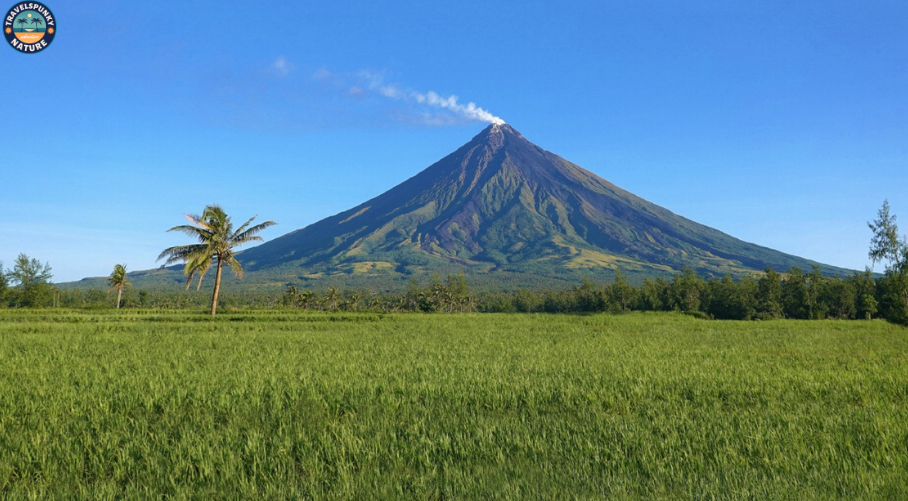
Mayon, in Albay province, is the most active volcano in the Philippines and its most symmetrical cone, rising about 2,462 m above Albay Gulf. It has erupted more than 50 times in recorded history. The classic place to see it is the Cagsawa Ruins in Daraga, where a Franciscan church bell tower stands in a park. The rest of the church was buried in the eruption of 1814, which killed about 1,200 people. In quieter times, ATV tours cross the lava fields at its foot, and viewpoints such as Lignon Hill look straight at the cone.
That quiet cannot be assumed now. Mayon is erupting as this guide is published.
Safety: PHIVOLCS raised Mayon to Alert Level 3 on 30 October 2026 after a moderately explosive eruption, and eruptions continued into November 2026, with a new lava dome in the crater. Entry into the 6 km Permanent Danger Zone is strictly prohibited, nearby residents have been evacuated, and tours close to the volcano cannot be assumed to run. Check the current bulletin before planning any trip to Albay.
Cost: Cagsawa Ruins Park charges a small fee of about ₱20 to ₱45. In normal times the standard ATV trails cost about ₱1,500 to ₱3,000 per person.
The honest downside: Even in calm years, cloud hides the cone on many days, and the clearest views come early in the morning.
6. Taal Volcano and Tagaytay
Taal is one of the smallest active volcanoes in the world, and one of the strangest sights in the country. A wide caldera lake fills the crater of an older, much bigger volcano. Inside the lake sits Volcano Island, and inside the island’s crater sits another lake. From the ridge town of Tagaytay, about an hour and a half to two hours south of Manila, the whole arrangement spreads out below you.
Older guides describe a boat across the lake and a hike up the island to the crater rim. That trip no longer exists. Taal erupted in January 2020, and the island has been closed ever since.
Safety: PHIVOLCS keeps Taal at Alert Level 1, low-level unrest, and Volcano Island is a Permanent Danger Zone. Entry to the island is prohibited, and the volcano still produces occasional small steam-driven eruptions, as it did in October 2025. Treat any offer of a boat trip to the island as one to refuse.
Cost: The Tagaytay viewpoints cost nothing beyond what you eat and drink along the ridge.
The honest downside: You are looking at this landmark, not visiting it, and from the ridge the island is smaller than the photographs suggest. Taal works best as a relaxed day of cool air and a famous view, not as an adventure stop.
7. Mount Pinatubo Crater Lake
On 15 June 1991, Mount Pinatubo produced the second largest volcanic eruption of the 20th century. The mountain lost about 300 m of height, and rain slowly filled the new crater with a milky turquoise lake. The trip to see it is a small expedition. You register before dawn at the tourism office in Santa Juliana, Capas, in Tarlac, ride a 4×4 for about an hour across the grey lahar plains, then walk to the crater rim. The walk runs about 5 km each way on the long trail, and less in the dry season, when jeeps can drive closer.
The lake sits at about 960 m, ringed by the crater walls. Swimming in it is prohibited, so the reward is the view, the silence and a picnic on the shore.
Cost: Shared day tours from Manila start at about ₱2,800 per person. Arranged on the spot, a 4×4 costs about ₱3,000 to ₱3,500 per jeep for up to five people, a guide about ₱500 per group, the Capas conservation fee about ₱300 per person, and a Botolan community fee of about ₱400 to ₱700 per person.
Booking: Registration runs from about 5 AM and dispatch stops at about 7 AM, so this is a pre-dawn start. Foreign visitors need a clearance arranged in advance through an accredited operator, because the route crosses military land. Operators also set age and health rules for the trek.
The honest downside: Heavy rain sends lahars down the river crossings and cancels tours, which is why the trek runs in the dry season, roughly December to May. Build a spare day into your plans.
8. Chocolate Hills and the Tarsier Sanctuary, Bohol

Bohol’s interior holds a field of more than 1,200 grass-covered limestone hills, almost identical cones of about 30 to 120 m, spread over about 50 km². In the dry season the grass burns brown, and the Chocolate Hills earn their name. The main viewpoint is the Chocolate Hills Complex in Carmen, about 55 km from Tagbilaran, where about 214 steps climb to a 360 degree deck. Bohol was named the first UNESCO Global Geopark in the Philippines in 2023.
On the way back toward the coast, stop at Corella, about 14 km from Tagbilaran, where the Philippine Tarsier Foundation runs a sanctuary in protected forest. The Philippine tarsier is one of the smallest primates in the world, about 10 to 16 cm tall, with huge eyes. The animals are nocturnal, so a daytime visit means watching them sleep, in silence, on a short guided walk.
Cost: The Chocolate Hills Complex charges ₱150 for an adult from outside Bohol under the rate that took effect in October 2025, and children pay less. The tarsier sanctuary fee is reported between about ₱60 and ₱150, so confirm at the gate.
Worth knowing: Choose the foundation’s sanctuary in Corella, not the roadside enclosures near Loboc, where tarsiers are kept in cages for photographs.
The honest downside: In the wet months the hills are green, not chocolate, and the viewing deck climb is in full sun. The tarsier visit is short and quiet by design.
9. Puerto Princesa Underground River
Near Sabang, on Palawan’s west coast, a river runs for 8.2 km beneath a limestone mountain and out into the sea. The Puerto Princesa Subterranean River was listed by UNESCO in 1999 and named one of the New7Wonders of Nature in 2011. Visitors see its first stretch from a paddle boat, about 1.5 km and 45 minutes in the dark, past stalactites, stalagmites and colonies of bats. An audio guide does the talking, so the cave stays quiet.
The day runs to a set pattern. A van ride of about 1.5 to 2 hours from Puerto Princesa city reaches Sabang, a short motor boat crosses to the park beach, and the paddle boats leave from the cave mouth. Numbers are controlled to protect the cave, which is why the permit system below matters so much here.
Cost: The entrance permit costs about ₱500 for an adult, the environmental fee about ₱150 and the audio guide about ₱85, with the boat from Sabang charged on top. A shared day tour with transfers and lunch costs about ₱2,200 to ₱2,700 per person.
Booking: Every visitor needs a permit, and the park caps entry at about 900 people a day. Tours arrange the permit for you. Independent travellers apply at the park booking office in Puerto Princesa city with photo ID, well ahead in the March to May peak.
The honest downside: It is a long day for a 45 minute boat ride, and rough seas can cancel the Sabang crossing at short notice. Keep a spare day in Puerto Princesa.
10. El Nido and the Bacuit Bay Lagoons
El Nido, at the northern tip of Palawan, looks out over Bacuit Bay and its 45 islands and islets of grey limestone. The landmarks here are the lagoons. On Miniloc Island, the Big Lagoon is a corridor of clear green water between cliffs, entered by kayak, and the Secret Lagoon hides behind a small opening in the rock. Boat tours run on four set routes, lettered A to D, and Tour A is the lagoon route.
This section stays short, because El Nido’s beaches have their own guide on this site. For the sand itself, see our guide to the best beaches in the Philippines. What belongs here is the fee and booking system, because lagoon entry is managed by time slots.
Cost: A shared Tour A costs about ₱1,200 to ₱1,500 per person. On top, every visitor pays the Eco-Tourism Development Fee of ₱400, valid for ten days, and the Big Lagoon and Small Lagoon each carry a user fee of about ₱200. Kayaks cost about ₱300 to ₱400.
Worth knowing: The Big Lagoon and the Small Lagoon cannot be visited on the same day, and lagoon places are capped, so operators book slots in advance. Small planes fly to Lio Airport from Manila and Clark, and the road from Puerto Princesa takes about 5 to 6 hours.
The honest downside: The fees stack up, the Big Lagoon is busy in every slot, and wet season seas cancel boats. El Nido rewards at least three nights.
11. Tubbataha Reefs
Tubbataha Reefs Natural Park protects about 97,030 hectares of reef in the middle of the Sulu Sea, about 150 km southeast of Puerto Princesa. UNESCO listed it in 1993. Two atolls and a reef hold some of the richest marine life in the Coral Triangle, with reef sharks, turtles and manta rays, guarded by rangers who live on a platform in the open sea.
There is no island to land on, no hotel and no day trip. The only way in is a liveaboard dive boat from Puerto Princesa, an overnight crossing of about 10 to 12 hours, for a trip of about six nights. The park opens to divers for about three months a year, from mid-March to mid-June.
Cost: The park fee is ₱5,000 per person, paid on top of the liveaboard fare. Six-night trips ranged from about ₱95,000 to well over ₱250,000 per person in recent seasons, depending on the boat.
Booking: Boats ask for an Advanced Open Water certificate and about 50 logged dives, because the walls and currents are serious. The season is short and the boats are few, so book six to twelve months ahead.
The honest downside: This landmark is for experienced divers only, and it is the most expensive entry in this guide by a long way.
Best time to visit the Philippines’ landmarks
The dry season, from about November to May, is the working season for most of this list, and December to February brings the coolest, driest weather. Some landmarks run on their own clocks. The Banaue and Batad terraces are greenest from about April to June, the Chocolate Hills turn brown late in the dry season, and Tubbataha opens only from mid-March to mid-June.
The wet season, from about June to October, brings typhoons, cancelled boats and closed trails. Volcanoes ignore the calendar altogether, so check the PHIVOLCS bulletins for Mayon and Taal in the week of your trip, not the month.
How to reach the Philippines, and getting around
The landmarks in this guide spread across three island groups, Luzon, the Visayas and Palawan, and no single base covers them. Plan the trip as two or three regional legs, not one long drive.
By air: Manila’s Ninoy Aquino airport is the main gate, with Clark as the second Luzon airport. Mactan-Cebu serves the Visayas, and Puerto Princesa serves Palawan. Domestic flights of about an hour link Manila with Cebu, Panglao and Puerto Princesa, and save whole days over ferries.
By road: Luzon’s landmarks run on long bus rides, about 9 hours to Banaue and about 8 to 10 hours to Vigan. Book overnight buses for the northern trips and sleep through them.
By boat: Ferries link the islands for travellers with time, and every Palawan landmark here starts from a boat, from the Sabang crossing to a liveaboard.
Money: The currency is the peso. Cards work in cities and resorts, but the fees in this guide are mostly paid in cash, so carry small bills.
Where to base yourself for each landmark
This table matches each base to the landmarks it covers best.
| No. | Base | Landmarks it covers | Good to know |
|---|---|---|---|
| 1 | Manila | Intramuros and Fort Santiago, and Pinatubo as a long day trip | Ermita, Malate and Makati give the easiest trips to the old city |
| 2 | Tagaytay | Taal Volcano viewpoints | A cool ridge town, busy with Manila weekenders |
| 3 | Legazpi | Mayon Volcano and the Cagsawa Ruins | The city faces the cone, so a clear morning needs no travel |
| 4 | Vigan | Calle Crisologo and the heritage zone | Sleep inside the heritage zone and walk everywhere |
| 5 | Banaue town | The Banaue viewpoints and Batad | Simple lodges, and the base for guides and tricycles |
| 6 | Cebu City | Magellan’s Cross, the Basilica and Fort San Pedro | The heritage sights fill one downtown half day |
| 7 | Tagbilaran or Panglao, Bohol | Chocolate Hills and the Tarsier Sanctuary | Panglao adds the beach to the same countryside day |
| 8 | Puerto Princesa | The Underground River, and Tubbataha liveaboards | The permit office and the port in one city |
| 9 | El Nido town | The Bacuit Bay lagoons | Give it at least three nights |
FAQs
1. What is the most famous landmark in the Philippines?
The Chocolate Hills are the most recognised natural image of the country, and Intramuros is its most famous historic district. If a trip allows only two landmarks, build it around those two.
2. Can you still visit Taal Volcano Island?
No. The island has been closed since the January 2020 eruption, and PHIVOLCS lists the whole island as a Permanent Danger Zone at Alert Level 1. The landmark today is the view from the Tagaytay ridge, and any boat trip offered to the island should be refused.
3. Is it safe to visit Mayon Volcano?
Check the alert level first, because it changes. As this guide was published in November 2026, Mayon stood at Alert Level 3 and was erupting, with the 6 km danger zone closed and residents evacuated. In calm periods the volcano is watched from viewpoints such as the Cagsawa Ruins, outside the danger zone.
4. How many days do you need for these landmarks?
About ten to fourteen days covers a sensible circuit, Manila and northern Luzon, one Visayas leg and one Palawan leg. The landmarks sit in three island groups, so a short trip cannot hold all eleven.
5. Do you need to book the Underground River in advance?
Yes. Entry is by permit only, and the park caps visitors at about 900 a day. Book a tour, or apply at the booking office in Puerto Princesa city, well ahead in the March to May peak.
6. What is the best month to visit the Philippines’ landmarks?
February, if one month has to be named. The dry season is settled, the seas are calm and the Chocolate Hills are turning brown. For the greenest rice terraces, shift the northern Luzon leg to April or May.
Researched and verified: November 2026. This guide is research-based, compiled from official visitor information, maps and traveller reports. Prices, hours and road conditions change, so confirm them locally before travelling.