Morocco packs more variety into one trip than almost any country its size. In a single circuit you can get lost in the alleys of Fes el Bali in the morning, cross the High Atlas by road the next day, and finish the week in front of the tallest minaret in the world in Casablanca. Four of the places in this guide hold UNESCO World Heritage status, and the classic route between them is half the pleasure of the trip.
This guide lists the seven places that matter most on a first trip, with the practical facts attached to each one, what it costs, when it is open and how to reach it. Prices in Morocco are usually paid in cash and change often, so where sources disagree, this guide gives a range and says to confirm before you book. The Sahara appears only as a short gateway section at the end, because the desert has its own full guide on this site.
At a glance
| No. | Place | Where | Best for | Known for |
|---|---|---|---|---|
| 1 | Marrakech | South, at the foot of the High Atlas | A first base and the big sights | Jemaa el-Fnaa, the Bahia Palace and the Jardin Majorelle |
| 2 | Fes | North east, inland | History and crafts | Fes el Bali, the world’s largest car-free medina, and the Chouara Tannery |
| 3 | Chefchaouen | Rif Mountains, north | Photos and a slow pace | The blue-washed medina, founded in 1471 |
| 4 | Casablanca | Atlantic coast, centre | One great sight and easy arrivals | The Hassan II Mosque, with the tallest minaret in the world |
| 5 | Essaouira | Atlantic coast, west | Coast air and calm | An 18th-century fortified port, ramparts and a working fishing harbour |
| 6 | Ait Benhaddou and the High Atlas | South of Marrakech | Mountain roads and film history | A UNESCO-listed earthen ksar and the road to Imlil and Toubkal |
| 7 | Merzouga | Edge of the Sahara, south east | The desert gateway | The village at the foot of the Erg Chebbi dunes |
1. Marrakech

Marrakech is where most Morocco trips begin, a city founded about 1070 whose old town, the medina, has been a UNESCO World Heritage Site since 1985. Its heart is Jemaa el-Fnaa, a vast square that fills at dusk with food stalls, drummers and crowds, and the 77 m minaret of the Koutoubia Mosque rises over everything as the city’s landmark. Like almost every working mosque in Morocco, the Koutoubia is closed to non-Muslims, so it is admired from outside.
South of the square stand the palaces. The Bahia Palace is a 19th-century maze of painted cedar ceilings and tiled courtyards, the Saadian Tombs hold ornate 16th-century mausoleums that stayed hidden until 1917, and the ruined El Badi Palace shows the scale of the court that built it. North of the square, the Ben Youssef Madrasa is the medina’s finest religious school open to visitors. In the new town, the Jardin Majorelle is the cobalt-blue garden once owned by Yves Saint Laurent, the one sight that must be booked days ahead.
Entry fees: The Bahia Palace, the Saadian Tombs and El Badi Palace each cost about 100 MAD for a foreign adult, and the Ben Youssef Madrasa about 50 MAD. The Jardin Majorelle costs about 170 MAD and sells timed tickets online only, so book it on the official ticket site several days ahead in busy months.
Opening hours: The main monuments open daily at about 9:00 AM and close at about 5:00 PM. Hours shift during Ramadan, so confirm on the day.
How to reach it: Marrakech Menara Airport is about 15 minutes by taxi from the medina. Trains run from Marrakech station to Casablanca in about 2 hours 40 minutes, and on to Fes in about 7 hours.
Best for: A first base in Morocco. Give it at least three nights, and four if you add a day trip into the Atlas.
2. Fes

Fes is the oldest of Morocco’s imperial cities, founded in 789, and its old town is the single most extraordinary urban sight in the country. Fes el Bali, a UNESCO World Heritage Site since 1981, is the largest car-free urban area in the world, a working medieval city of more than 9,000 alleys where goods still move by donkey and handcart. It asks more of visitors than Marrakech does, and it gives more back.
At its centre stands the University of al-Qarawiyyin, founded in 859 by Fatima al-Fihri and recognised by UNESCO and Guinness World Records as the oldest continuously operating university in the world. Its mosque is closed to non-Muslims, who glimpse the courtyard through the doorways. The interior visitors can enter is the Bou Inania Madrasa, a 14th-century Marinid masterpiece just inside the Bab Boujloud gate. The other essential stop is the Chouara Tannery, where leather is still dyed in stone vats much as it has been since the 11th century, watched from the terraces of the leather shops around it.
Entry fees: The medina itself is free. The Bou Inania and Al-Attarine madrasas charge a small cash fee, roughly 20 to 30 MAD, and the tannery terraces are free, though a tip of about 10 to 20 MAD is expected if you do not buy anything. Confirm prices at the door.
How to reach it: Trains reach Casablanca in about 4 hours and Tangier in about 4 to 5 hours. Fes-Sais Airport sits about 15 km south of the city, with taxis and a shuttle into town.
Best for: History above everything. Stay in a riad in or beside the medina, and hire a licensed guide for the first morning, because the alleys defeat phone maps.
3. Chefchaouen
Chefchaouen is the blue town in the Rif Mountains, founded in 1471 as a fortress against Portuguese expansion and now famous for a medina washed in every shade of blue. Why the town is blue is debated, the explanations run from spiritual symbolism brought by Jewish refugees in the 1930s to a tradition that simply kept spreading, but the effect is not in doubt, whole lanes of blue walls, blue steps and blue doors climbing the hillside.
The centre is Place Outa el Hammam, a shaded square with cafes and the town’s kasbah, a restored fortress with a small museum and a tower to climb. At the edge of the medina, the Ras el-Maa waterfall is where local families cool off, and a path of about 30 minutes climbs to the Spanish Mosque, the classic sunset viewpoint over the blue roofs. Chefchaouen is not a place of big sights. It is a place to slow down for a night or two between the intensity of Fes and the coast.
Cost: The medina is free to wander. The kasbah museum charges a small entry fee, so confirm the current price at the gate.
How to reach it: There is no train and no airport, so everyone arrives by road. CTM buses run from Tangier in about 2 hours 30 minutes and from Fes in about 4 to 4 hours 30 minutes, and the bus station sits a 15-minute uphill walk below the medina.
Best for: Photographers, and anyone who wants one slow stop on a northern circuit.
4. Casablanca
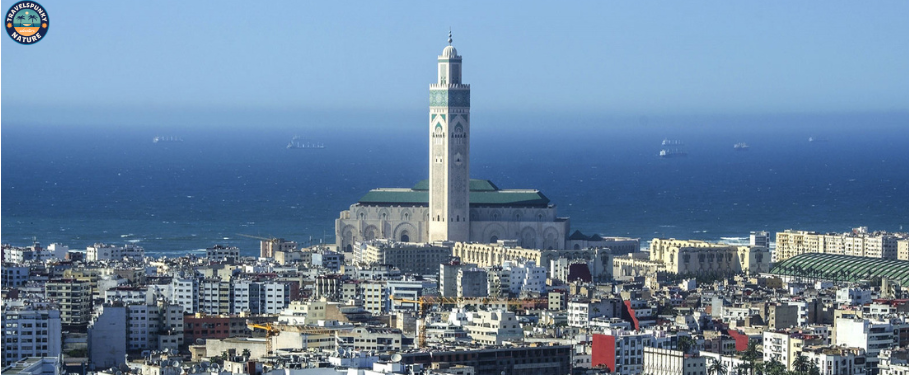
Casablanca is Morocco’s largest city and its business capital, and most visitors pass through it on the way to somewhere else. It earns its place on this list for one building. The Hassan II Mosque, completed in 1993 and built partly out over the Atlantic, is the largest mosque in Morocco, and its minaret rises 210 m, the tallest in the world. It is also one of the only mosques in the country that non-Muslims may enter, on official guided tours run by the mosque’s own foundation.
The tour, about 45 minutes, takes in the vast prayer hall, the carved cedar and zellige tilework and the ablution halls below. Beyond the mosque, Casablanca is a working city rather than a sightseeing one, with a small old medina, an Art Deco centre and Rick’s Cafe, a recreation of the bar from the film Casablanca, which was shot entirely in Hollywood. One night is enough for most trips.
Entry fee: The guided mosque tour costs about 140 MAD for a foreign adult, with lower rates for students and children. Tickets are sold at the mosque, and the price should be confirmed before you go.
Tour times: Tours run several times a day from Saturday to Thursday, typically at 9:00, 10:00, 11:00 and 12:00 with more in the afternoon, and fewer on Friday. Shoulders and knees must be covered, shoes come off inside, and the schedule changes during Ramadan, so check the day before.
How to reach it: Mohammed V Airport is about 45 minutes from the centre by train or taxi. Trains run to Rabat in about 1 hour, Marrakech in about 2 hours 40 minutes and Fes in about 4 hours.
Best for: A first or last night in Morocco, and the one mosque interior every visitor can see.
5. Essaouira
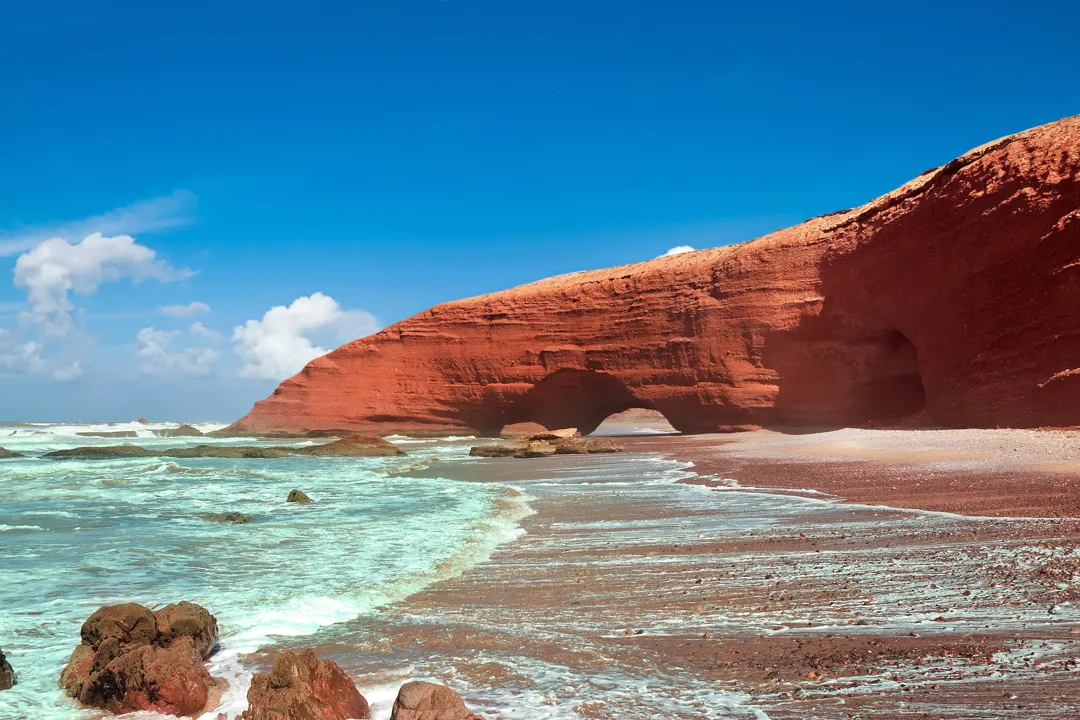
Essaouira is the calm face of the Moroccan coast, a white and blue port town laid out in the 18th century as Mogador, the trading harbour of the south. Its medina, a UNESCO World Heritage Site since 2001, is small, orderly and almost impossible to get lost in, which makes it the gentlest old town in the country. The ramparts of the Skala look out over the Atlantic, and below them the fishing port lands its catch beside rows of blue boats and fish grills.
The town runs on crafts and music as much as fish. Workshops carve thuya wood, galleries line the main streets, and Gnaoua music builds to a world music festival usually held in early summer. Essaouira is famously windy, a serious kitesurfing base, and far cooler than Marrakech, so pack a layer even in July. Its beach is wide but the water is rough, and we cover it properly in our Morocco beaches guide rather than here.
Cost: The medina, the ramparts and the port are all free to wander.
How to reach it: There is no train. Supratours and CTM buses run from Marrakech in about 3 hours, roughly 90 to 140 MAD one way, and stop a short walk from the medina gate.
Best for: Two slow nights after the intensity of Marrakech, or an easy first taste of Morocco.
6. Ait Benhaddou and the High Atlas
South of Marrakech, the road climbs into the High Atlas and over the Tizi n’Tichka pass at 2,260 m, and the drive itself is one of the great journeys in Morocco. On the far side of the mountains stands Ait Benhaddou, a ksar, or fortified village, of earthen towers and houses on the old caravan route between the Sahara and Marrakech, and a UNESCO World Heritage Site since 1987. Its hilltop granary, decorated clay facades and film history (Lawrence of Arabia, Gladiator and Game of Thrones all shot scenes here) make it the most famous village in the south. Most families now live in the newer village across the river, and parts of the ksar were damaged in the earthquake of September 2023, so restoration work continues alongside the visits.
The Atlas has a second, greener face. Imlil, a village at 1,740 m about 65 km south of Marrakech, is the trailhead for Jbel Toubkal, at 4,167 m the highest peak in North Africa. The summit is a two-day trek with a licensed guide and a night in a refuge, but a day trip to Imlil for a walk between terraced villages is enough for most visitors. Ait Benhaddou pairs with Ouarzazate, about 30 minutes further on, home to the Atlas Film Studios.
Cost: A shared day trip from Marrakech to Ait Benhaddou runs roughly 350 to 600 MAD per person, and a private car costs more. Confirm what the price includes before you book.
How to reach it: Ait Benhaddou is about 190 km from Marrakech, roughly 3 hours 30 minutes to 4 hours by road. Imlil is about 65 km and 1 hour 30 minutes from Marrakech by grand taxi or day tour.
Best for: A long day trip from Marrakech, or better, a night in Ouarzazate on the way south to the desert.
7. Merzouga, the Gateway to the Sahara
Merzouga is a small village at the edge of Erg Chebbi, the most accessible of Morocco’s great dune fields, and it is the standard gateway for a camel trek and a night in a desert camp. It is a long way from everywhere, about 560 km from Marrakech and a drive of about 7 to 8 hours from Fes, and almost everyone arrives on a shared or private tour that splits the journey over two or three days, stopping at Ait Benhaddou and the Todra Gorges on the way.
That is all this guide says about the desert, on purpose. Erg Chebbi, Erg Chigaga, Zagora and the Agafay each work differently, and camp quality varies enormously. We cover all of it, with real costs and how the tours actually run, in our full guide to the deserts in Morocco.
Best for: One or two nights in the dunes as the finale of a circuit. It cannot be done as a day trip from any city, so build the days around it.
Best time to visit Morocco
The sweet spots are spring, from March to May, and autumn, from September to November, when the cities are warm without being fierce and the Atlas passes are usually clear. These are also the busiest and priciest months, so book riads and desert tours ahead.
Summer splits the country in two. The coast stays pleasant, and Essaouira and Tangier are at their best, but Marrakech and Fes regularly pass 40 C and the Sahara is extreme. Winter brings mild days in the cities, cold nights in the desert and the mountains, and occasional snow that can close the Tizi n’Tichka pass for a day or two. Ramadan moves about ten days earlier each year and changes the rhythm of the country, so check the dates for your trip.
How to reach Morocco, and getting around
Most visitors fly into Casablanca, Marrakech or Tangier, all with direct flights from Europe, and Tangier also has ferries from Spain. Once inside the country, the pattern is simple, trains for the northern cities, buses and tours for everywhere else.
By train: The ONCF network links Tangier, Rabat, Casablanca, Meknes, Fes and Marrakech. The Al Boraq high-speed train covers Tangier to Casablanca in about 2 hours 10 minutes at speeds of up to 320 km/h, and classic trains take about 2 hours 40 minutes from Casablanca to Marrakech and about 4 hours from Casablanca to Fes. Book on the ONCF voyages site, and note that no railway runs south of Marrakech or reaches Chefchaouen or Essaouira.
By bus: CTM and Supratours coaches fill the gaps the trains leave, to Essaouira, Chefchaouen and the desert gateways. They are comfortable, cheap and bookable online, and worth booking a day or two ahead in busy months.
By taxi and car: Petit taxis are metered inside cities, so insist on the meter or agree the fare first. Grand taxis run shared intercity routes, and a rental car suits the south, where the mountain and desert roads reward flexibility.
Entry rules: Many nationalities, including visitors from the US, the UK and the EU, receive up to 90 days in Morocco without a visa. Rules differ by passport, so check yours before you book. The currency is the Moroccan dirham (MAD), roughly 10 to the US dollar, and it is a closed currency, so change money after you arrive and keep cash for medina shopping, entry fees and small towns.
Where to stay in Morocco
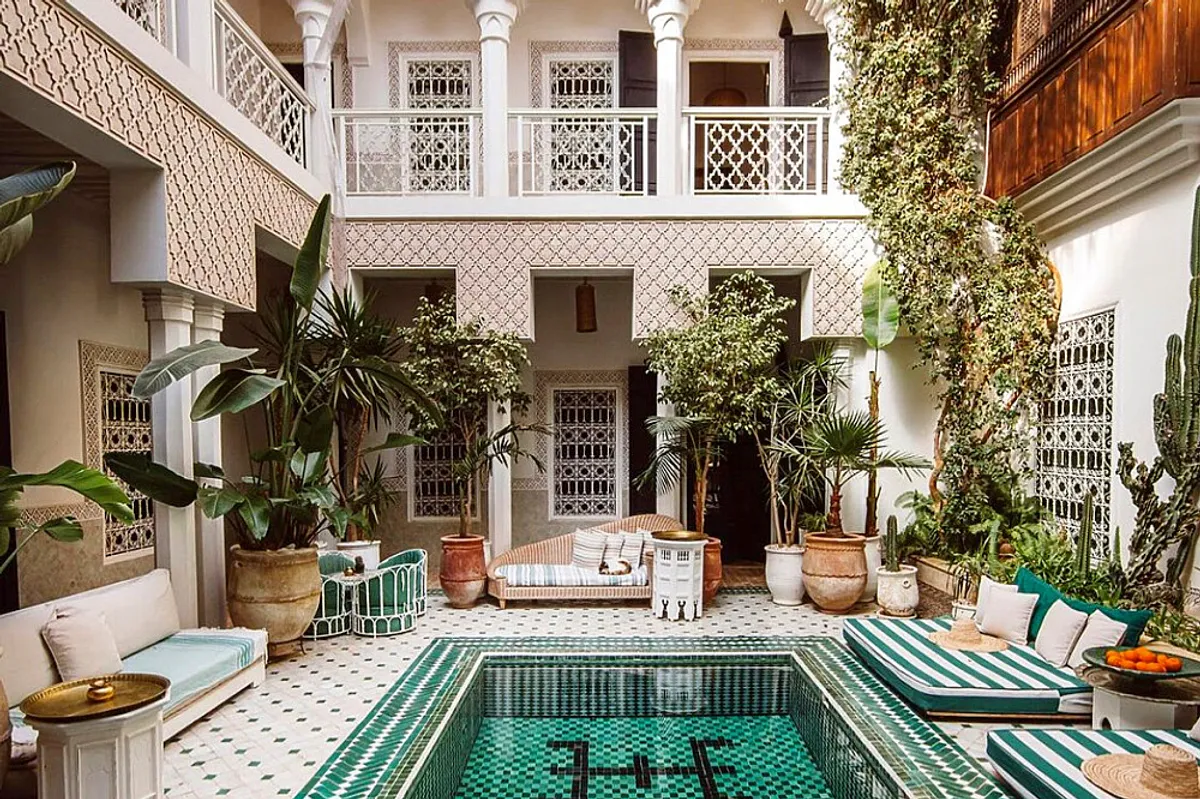
The classic Moroccan stay is a riad, a traditional house built around an interior courtyard garden, usually with a small pool or fountain at its heart and rooms arranged around it. The medinas of Marrakech and Fes are full of riads converted into guesthouses, and staying in one puts you inside the old town’s life. Hotels in the newer districts of both cities trade atmosphere for easy taxi access and bigger facilities.
A comfortable pattern gives Marrakech three or four nights, Fes two or three, Chefchaouen and Essaouira one or two each, and Casablanca a single night timed around the mosque tour. Riad prices vary too widely by city and season for one honest figure to cover them, so compare several before you book, and book early for spring and autumn.
FAQs
1. How many days do you need in Morocco?
Ten to fourteen days covers the classic circuit well, Casablanca, Fes and Chefchaouen in the north, then Marrakech, Ait Benhaddou or the Atlas, and a night or two in the desert. A week is enough for Marrakech, Fes and one more stop. Distances are long, so fewer bases with more nights in each beats rushing.
2. What is the best month to visit Morocco?
April and May are hard to beat, with warm cities, green countryside and the desert still manageable. Late September to November runs them close. December to February is quieter but cold at night in the mountains and desert, and June to August suits the coast far better than the interior.
3. Can non-Muslims go inside mosques in Morocco?
Almost all working mosques in Morocco are closed to non-Muslims. The great exception is the Hassan II Mosque in Casablanca, which runs official guided tours for about 140 MAD. Madrasas such as Bou Inania in Fes and Ben Youssef in Marrakech are religious schools rather than mosques, and they welcome visitors for a small fee.
4. How do you get from Marrakech to the Sahara?
By road, on a tour. Shared and private tours run from Marrakech to Merzouga and the Erg Chebbi dunes over two or three days each way, stopping at Ait Benhaddou and the Todra Gorges. There is no train and no day-trip option. Our deserts in Morocco guide explains how the tours, camps and prices work.
5. Is Morocco safe for tourists?
Morocco is one of the most visited countries in Africa and is generally safe for tourists. The common problems are hassle rather than danger, unofficial guides, shops insisting a sight is closed, and unmetered taxi fares. Use licensed guides, agree every fare before you set off, and take the same care you would in any large city.
6. What should you wear in Morocco?
There is no dress code law for visitors, but modest dress, covering shoulders and knees, is respectful and makes life easier, especially in medinas and rural areas. Women are not expected to cover their hair in public. For the Hassan II Mosque tour, shoulders and knees must be covered and shoes are removed inside.
Researched and verified: November 2026. This guide is research-based, compiled from official visitor information, maps and traveller reports. Prices, hours and road conditions change, so confirm them locally before travelling.