The Sahara, a desert the size of a continent
The Sahara is the largest hot desert in the world, and the word largest needs care. At about 9.2 million square kilometres it covers 31 percent of Africa, an area comparable to China or the whole United States, and it runs some 4,800 kilometres from the Atlantic Ocean in the west to the Red Sea in the east. The only deserts bigger than it are the polar deserts of Antarctica and the Arctic, which is why the honest title is the world’s largest hot desert. Parts of ten countries lie inside it, Algeria, Chad, Egypt, Libya, Mali, Mauritania, Morocco, Niger, Sudan and Tunisia, plus the territory of Western Sahara, and yet only about 2.5 million people live in the whole of it.
The second surprise is how little of it is sand. The rolling dune seas of the photographs, called ergs, cover only about a quarter of the Sahara. The rest is hamada, bare rocky plateau, reg, plains of gravel and small stones, salt flats, dry valleys and real mountain ranges. The highest ground is volcanic, and the Tibesti range in northern Chad tops out at Emi Koussi, about 3,415 metres, the highest point in the Sahara. Nor was it always dry. As recently as about 5,000 years ago this was a green land of lakes, rivers and grazing animals, and the proof is painted on its rocks, in the giraffes, cattle and swimmers of Saharan rock art.
The old version of this post listed five activities and skipped the desert itself. This version explains the regions a visitor can realistically reach, then how trips work anywhere in the Sahara, then the best time to go. Morocco gets a short section only, because its ergs, tours, camps and costs already have their own full guide on this site, linked below.
At a glance
| No. | Region | Where | Known for | Gateway |
|---|---|---|---|---|
| 1 | Erg Chebbi and Erg Chigaga | Morocco | Big dunes, camel treks and desert camps | Merzouga and M’Hamid |
| 2 | Grand Erg Oriental | Tunisia and Algeria | One of the great sand seas, oasis camps | Douz and Ksar Ghilane |
| 3 | Tassili n’Ajjer | South-east Algeria | Prehistoric rock art and stone forests | Djanet |
| 4 | The Western Desert | Egypt | White Desert chalk formations, old oases | Bahariya and Cairo |
| 5 | The Adrar | Mauritania | Caravan towns and manuscript libraries | Atar and Chinguetti |
| 6 | Ennedi Plateau | North-east Chad | Natural arches, rock art, desert crocodiles | Expedition from N’Djamena |
1. Morocco’s ergs, the easiest first Sahara
For most first-time visitors, the Sahara means Morocco, and Morocco means two dune fields in the south-east of the country. Erg Chebbi, beside the village of Merzouga, is the classic, a compact sea of high dunes reached on organised tours of two to four days from Marrakech or Fes. Erg Chigaga, beyond M’Hamid, is bigger, lower and remoter, and reaching it takes a longer drive and a stretch off road. A standard trip in either place runs the same way, a camel ride into the dunes at sunset, a night in a desert camp, and a sunrise over the sand before the ride back.
Worth knowing: Morocco’s desert areas, tour formats, real costs, the difference between standard and luxury camps and the honest warnings are all covered in our full guide to the deserts of Morocco, so this post does not repeat them.
2. Tunisia, Douz and the Grand Erg Oriental
Tunisia offers the gentlest introduction to the deep Sahara. The town of Douz, about 530 kilometres south of Tunis, markets itself as the gateway to the Sahara, and the dunes of the Grand Erg Oriental genuinely begin at the edge of town. That erg, shared with Algeria, is one of the largest sand seas on Earth, and from Douz the standard products are an hour’s camel ride at sunset, an overnight camp in the dunes, or a proper camel trek of two to four days walking and riding between bivouacs. Operator prices for a trekking day with meals and camp are commonly quoted around 120 to 200 Tunisian dinars per person, and they move with group size and season, so confirm locally before paying.
The classic excursion is Ksar Ghilane, a small oasis some 90 kilometres east across stony desert, where a warm spring pool sits at the foot of the dunes and several camps take overnight guests. Douz also hosts the International Festival of the Sahara in late December, and Tozeur, to the west, pairs the desert with the Chott el Jerid salt lake.
How to reach it: Fly to Tunis, then a long day’s drive or a domestic hop south, with most tours collecting guests in Douz or Tozeur.
3. Algeria, the Tassili n’Ajjer and the deep south
Algeria holds the largest share of the Sahara and its single greatest treasure. The Tassili n’Ajjer is a sandstone plateau in the far south-east, near the borders with Libya and Niger, where erosion has cut the rock into forests of stone pillars, arches and canyons. On the shelter walls of that plateau sit more than 15,000 prehistoric paintings and engravings, the oldest going back some 12,000 years, showing cattle herders, hunters and animals that vanished as the desert dried. UNESCO listed the plateau as a World Heritage site in 1982, for its culture and its landscape together, and the protected park covers about 72,000 square kilometres.
Trips here are treks, not excursions. From the oasis town of Djanet, reached by domestic flight from Algiers, groups climb onto the plateau on foot with a local guide and spend four days to a week walking between art sites, sleeping in bivouacs. A park permit and an authorised guide are compulsory, not optional, and since 2023 many visitors on escorted southern tours have been able to use a pre-arranged visa on arrival organised by an approved Algerian agency, rather than a consulate visa. The Hoggar mountains around Tamanrasset are the country’s other desert draw, run by the same agencies.
Cost: An organised Tassili trek is a multi-day guided expedition and is priced like one. Get the full breakdown, permits, visa handling, food and camping, in writing before you commit.
4. Egypt’s Western Desert, the White Desert and the oases
Egypt’s share of the Sahara, everything west of the Nile, is called the Western Desert, and its headline sight needs no dunes at all. The White Desert, protected as a national park since 2002, is a field of chalk rock that wind has carved into towers, mushrooms and animal shapes, white at noon and gold at sunset. Almost every trip follows the same route from Cairo, about four to five hours by road to Bahariya Oasis, then on by 4×4 through the black volcanic hills of the Black Desert and past the quartz ridge called Crystal Mountain, ending with a night camped among the chalk formations. Two days and one night is the standard shape, and the trip needs a licensed operator and permits arranged in advance.
Cost: Quoted prices for the standard two-day trip vary widely between operators and group sizes, so compare what is included, vehicle, meals, camping gear and park fees, rather than the headline number.
Further west, near the Libyan border, the oasis of Siwa is a destination of its own, famous for the ancient Oracle of Amun. It is a long journey from Cairo and normally a separate trip rather than an add-on.
5. Mauritania, Chinguetti and the Adrar caravan towns
Mauritania is two-thirds Sahara, and its desert travel is about towns as much as dunes. In the Adrar region, the old caravan cities of Chinguetti and Ouadane grew rich between the 11th and 16th centuries on trade across the desert, and together with Tichitt and Oualata they are listed by UNESCO as the Ancient Ksour, a World Heritage site since 1996. Chinguetti is the famous one, a town of stone houses slowly being taken by the sand, where family libraries still keep thousands of old manuscripts, some of them centuries old, in wooden chests. The gateway is Atar, about 450 kilometres north-east of the capital Nouakchott, and trips run on to Ouadane and the Richat Structure, the great ringed formation, nicknamed the Eye of the Sahara, that astronauts use as a landmark.
Travel here is organised travel. Distances are long, roads are few, and the standard pattern is a guided 4×4 circuit of a week or more, sometimes finishing with a ride on the iron ore railway that runs some 700 kilometres between Zouérat and the coast at Nouadhibou, on some of the longest trains in the world.
Worth knowing: Advice levels for parts of Mauritania are high, and operators arrange the permissions the northern routes need. Check current advice for the exact route, not just the country, before booking.
6. Chad, the Ennedi Plateau, expedition country
The Ennedi Plateau in north-east Chad is the Sahara at its most spectacular and its least visited. Wind and water have carved its sandstone into towers, slot canyons and natural arches, including the Aloba Arch, roughly 120 metres high and among the largest natural arches in the world. Its cliffs carry rock art going back some 7,000 years, and in the canyon pool of the Guelta d’Archei a small population of desert crocodiles survives, left behind when the Sahara dried, alongside the camel herds that still come down to drink. UNESCO listed the Ennedi Massif as a mixed natural and cultural World Heritage site in 2016, and the wider reserve is managed with the conservation organisation African Parks.
There is no casual way in. Ennedi lies about 1,300 kilometres from N’Djamena, the journey takes days by 4×4 convoy, and every trip is a small expedition with permits, a specialist operator and expedition pricing to match. Chad’s other desert listing, the Lakes of Ounianga, a chain of 18 lakes in the sand, joins the longest itineraries.
What a Sahara trip is actually like
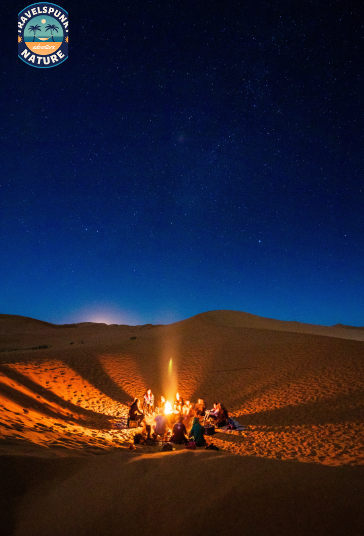
Wherever a Sahara trip starts, the formats repeat, because the desert sets the terms. The shortest is the sunset ride, an hour or two on a dromedary, the one-humped camel of the Sahara, out to a dune and back in the cool of the evening. The classic is the overnight camp, riding or driving in during the afternoon, eating around a fire, sleeping in a tent or under the open sky, and waking for sunrise, because a desert night is half the point. With no towns for hundreds of kilometres, the sky is as dark as skies get, and the Milky Way is what most visitors remember longest.


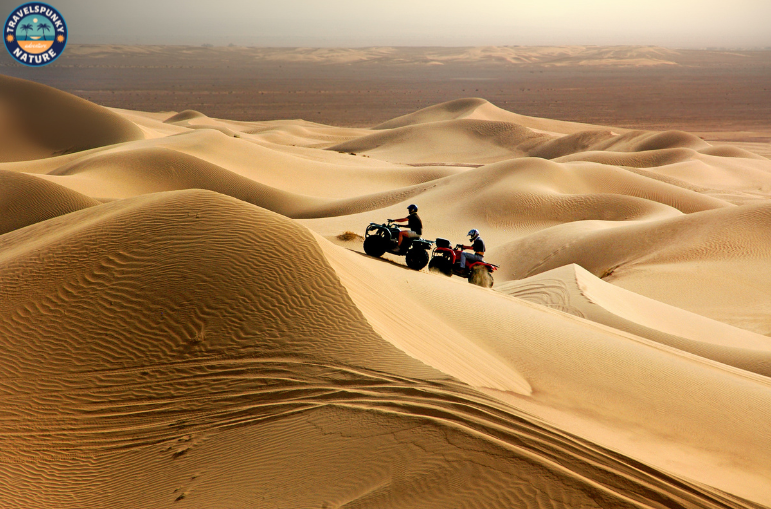
Beyond that, trips lengthen rather than change. A multi-day camel trek walks and rides between camps for two to six days, while the deep regions, Algeria, Chad and the far Libyan desert, are 4×4 expedition territory, where the vehicle carries the water, the food and the camp. Camps range from a mattress and a blanket around a fire to fixed luxury tents with beds and bathrooms, and that gap is where most of the price difference sits. Quad bikes are offered at some gateways, Douz and Merzouga among them, as short guided rides at the dune edge, best treated as an add-on rather than the main event.
Wildlife is real but shy, and honest expectations matter. The counts usually cited, from the World Wildlife Fund, are about 70 species of mammals, 90 of birds and 100 of reptiles across the whole desert. Most animals are small and nocturnal, jerboas, gerbils and the big-eared fennec fox, with dorcas gazelles and Barbary sheep in the rocky country and the addax, a critically endangered antelope, now rare everywhere. Dawn tracks in the sand are a likelier sighting than the animals themselves.

Best time to visit
For the best all-round weather: October to April is the working season almost everywhere in the Sahara, and November to February is the sweet spot, warm days for walking and riding, and clear skies.
For the deep south and expedition regions: The same window applies, October to March for the Tassili and Ennedi, when plateau days are mild. Winter nights anywhere in the desert are properly cold and can approach freezing, so the warm layers matter as much as the sun hat.
Months to avoid if possible: May to September. Daytime temperatures in the low desert regularly pass 45 degrees Celsius and can reach around 50, many camps close, and some operators suspend treks altogether in the hottest weeks.
One popular heat fact is worth correcting here. The 58 degrees Celsius said to have been recorded at Al Aziziyah in Libya in 1922 was the world’s official heat record for 90 years, until the World Meteorological Organization struck it out in 2012 as a bad reading. The Sahara is hot enough without the myth.
How trips are organised
Planning starts with a gateway. Fly into the country, travel to the desert town, Marrakech or Fes for Morocco, Tunis for Douz, Cairo for Bahariya, Algiers and a domestic flight for Djanet, Nouakchott for Atar, and from that town an operator takes over with the vehicle, the guide, the food and the camp. In Morocco and Tunisia a trip can be booked a few days ahead in the season. In Algeria, Egypt’s Western Desert and Chad, permits, licensed guides and, in places, escorts are part of the deal, and booking needs to start weeks ahead, visas included.
Good to know before going
- Check current travel advice for the exact region, not just the country. Some famous desert areas, much of Libya and Mali among them, are not realistic for ordinary trips at the moment, and border zones across the central Sahara carry the highest warnings.
- Travel with a licensed local operator and guide. Beyond the easy gateways there is no phone signal, no marked route and no help nearby, and in several regions a guide and permits are a legal requirement, not a preference.
- Water and sun decide the day. On organised trips the operator carries the water, but a hat, sunscreen and a refillable bottle are yours to manage, and midday in the dunes is for shade, not sightseeing.
- Pack for two climates in one day, light layers and a cover for the sun by day, and a genuinely warm jacket for winter nights in camp.
- Look at rock art, photograph it where photography is allowed, and never touch the paintings. The pigment has survived thousands of years on dry rock, and skin oils and water damage it.
- Protect phones and cameras from sand in sealed bags. Fine Saharan sand gets into everything, including zips and lens rings.
- Build travel days into the plan. The gateways are hundreds of kilometres from the capitals, and the deep regions are hundreds more from the gateways. The Sahara does not do quick trips.
Frequently asked questions
1. How big is the Sahara Desert?
About 9.2 million square kilometres, roughly 31 percent of Africa and an area comparable to China or the United States. It stretches some 4,800 kilometres from the Atlantic to the Red Sea.
2. Is the Sahara the largest desert in the world?
It is the largest hot desert in the world. The only deserts larger than it are polar, Antarctica first and the Arctic second, so the precise title matters.
3. What is the best month to visit the Sahara?
November to February is the safest single answer for most regions, with warm days and cold, clear nights. October and March run them close. Avoid May to September, when heat regularly passes 45 degrees Celsius.
4. Which country is best for a first Sahara trip?
Morocco and Tunisia are the easiest, with the shortest journeys, the widest choice of tours and prices, and camps for every budget. Our separate guide to the deserts of Morocco covers the Moroccan ergs in full.
5. How much does a Sahara trip cost?
It depends on the format more than the country. An hour’s sunset camel ride at a gateway town is cheap, an overnight camp trip sits in the middle, and a week-long expedition to the Tassili or the Ennedi is the expensive end, priced like the small expedition it is. Always confirm what a quote includes, vehicle, guide, meals, camp and permits, before comparing prices.
6. Is the Sahara safe to visit?
The visited gateways of Morocco, Tunisia and Egypt welcome large numbers of tourists each season on organised trips. The honest answer is regional, parts of the central Sahara are unsafe or closed to ordinary travel, so check current advice for the specific region and travel with a licensed operator.
Last updated, November 2026. Researched and verified from official visitor information and current travel guides.