Nigeria is the most populous country in Africa, with about 230 million people and 36 states. Its landmarks spread just as widely, from a rock on the Abuja road that appears on the 100 naira note to a sacred forest in Osun State and the longest canopy walkway in Africa.
This guide covers ten landmarks a visitor can realistically reach, in Abuja, Lagos and the south-west. Each entry gives what the place is, how to reach it, what it costs and where it falls short. Entry fees are printed as about figures in naira, because prices at Nigerian sites change often and are rarely published anywhere official.
One promise before the list. This guide states the safety position in plain language, further down this page. Parts of the country carry serious official travel warnings, and two famous sights are left out of this list for exactly that reason.
At a glance
| No. | Landmark | Where | Known for |
|---|---|---|---|
| 1 | Zuma Rock | Madalla, Niger State | The rock on the 100 naira note |
| 2 | Aso Rock and Millennium Park | Abuja | The capital’s backdrop and its largest park |
| 3 | Abuja National Mosque | Abuja | The national mosque, open to visitors |
| 4 | Lekki Conservation Centre | Lagos | The longest canopy walkway in Africa |
| 5 | Nike Art Gallery | Lagos | Thousands of artworks, free to enter |
| 6 | Lekki-Ikoyi Link Bridge | Lagos | The first cable-stayed bridge in West Africa |
| 7 | Olumo Rock | Abeokuta, Ogun State | The rock the Egba people sheltered inside |
| 8 | Osun-Osogbo Sacred Grove | Osogbo, Osun State | A UNESCO forest of shrines and sculptures |
| 9 | Erin Ijesha Waterfalls | Erin Ijesha, Osun State | Seven levels of falling water |
| 10 | Idanre Hills | Idanre, Ondo State | A whole old town on a hilltop |
1. Zuma Rock
Zuma Rock is a single great dome of igneous rock standing beside the Abuja to Kaduna expressway at Madalla, right where the road leaves the Federal Capital Territory. Its summit sits about 725 metres above sea level, and the rock rises roughly 300 metres above the plain around it. Weathering has marked one face with lines that many people read as a human face. The rock has been pictured on the 100 naira note since 1999, and its position on the capital’s northern road has earned it the nickname Gateway to Abuja. Local Gbagyi tradition holds that the rock sheltered their ancestors in times of war.

How to reach it: Drive from central Abuja towards Kaduna and Suleja, about 45 minutes in normal traffic. Most people see the rock on this drive, and the usual visit is a short stop at a lay-by for photographs.
Best months: November to February, when the rains have washed the dust off the rock and the light is clearest. Harmattan haze in December and January can soften the view on some mornings.
Good to know: There is no visitor centre, ticket gate or organised climb at Zuma Rock. It is a roadside sight. Reports describe a military presence near the base and restricted access, so do not wander towards the rock or try to climb without local guidance and permission.
Safety note: Zuma Rock stands just inside Niger State. The United States advisory of June 2026 places Niger State at Level 4, Do Not Travel, and the UK advises against all but essential travel there. Keep any stop short, in daylight and on the main road, check the current advice before you go, and read the travel-conditions note further down this page.
The honest catch: You are looking at the rock, not visiting it in any organised way. The whole experience can take fifteen minutes, and it only makes sense as part of a journey past it or a short drive out of Abuja with the safety note above firmly in mind.
2. Aso Rock and Millennium Park
Aso Rock is the granite monolith that watches over Abuja. Its peak reaches about 936 metres above sea level and about 400 metres above the land around it. At its foot sits the Three Arms Zone, the Presidential Villa, the National Assembly and the Supreme Court, which is why the rock’s name has become shorthand for the Nigerian presidency itself. Aso means victorious in the Gbagyi language. The villa grounds are a restricted security zone, so the rock is a landmark you admire from across the city rather than one you climb.

Millennium Park, a short drive away in Maitama, is the natural pairing. It is the largest public park in Abuja, about 32 hectares of lawns, fountains and shaded paths designed by the Italian architect Manfredi Nicoletti and opened by Queen Elizabeth II in December 2003. Entry is free, and the open grass gives a calm, clear view back to Aso Rock.
How to reach it: Both sights sit in central Abuja and are reached by taxi or ride-hailing. The park entrance stands on Shehu Shagari Way, near the Transcorp Hilton.
Best months: November to February, for dry lawns and the clearest views of the rock. Early morning is the quietest time in the park.
Good to know: The park opens daily from early morning to early evening and costs nothing to enter. Groups need permission for parties and events, but walkers, joggers and picnics are the everyday scene.
The honest catch: Aso Rock itself is a photograph, not an outing. Security staff will move you on if you linger near the villa approaches, and the park fills at weekends and on public holidays.
3. Abuja National Mosque
The National Mosque is the great domed building on Independence Avenue in Abuja’s Central District, completed in 1984. Its large central dome and four minarets anchor the capital’s skyline alongside Aso Rock. The complex includes a library, a conference hall and offices. The National Christian Centre, the national church, stands in the same district, and the two buildings together say a lot about the country. Visitors of every faith are welcome at the mosque outside prayer times, and entry is free.
How to reach it: The mosque stands in the Central District, a short taxi or ride-hailing trip from anywhere in central Abuja. Tell the staff at the gate that you are a visitor, and you will be directed to the office that handles tours.
Best months: Any month works, because this is a city sight. Weekday mornings between prayers are the easiest time for a tour. Friday brings the main weekly prayer and the biggest crowds.
Good to know: Dress modestly, with arms and legs covered, and women should cover their hair. Shoes come off before you enter the prayer hall. A staff guide usually shows visitors around, and a small tip is a fair thank you.
The honest catch: This is a working mosque first and a sight second. Access can be refused during prayers, on religious festivals and on national days when security tightens, and parts of the complex stay off limits to visitors.
4. Lekki Conservation Centre
The Lekki Conservation Centre protects about 78 hectares of wetland forest and savanna on the Lekki Peninsula in Lagos. The Nigerian Conservation Foundation has run it since 1990, and it feels like another world from the expressway outside. Boardwalks cross the swamp forest, mona monkeys work the paths for dropped snacks, and the birdlife is rich. The headline act is the canopy walkway, about 401 metres of suspended bridge through the treetops, the longest in Africa, rising about 22.5 metres above the ground at its highest point.
How to reach it: The centre stands on the Lekki-Epe Expressway near Chevron. Ride-hailing from Victoria Island or Lekki Phase 1 is the simple route, and the drive can take anything from 30 minutes to well over an hour depending on Lagos traffic.
Best months: November to March, when the boardwalks are driest. Go early in the day for the coolest air, the best birdlife and the shortest queue for the canopy walkway.
Good to know: Recent visitor reports put entry at about 3,000 naira and a combined ticket with the canopy walk at about 8,000 naira, but prices change often, so confirm before you travel. Payment is cashless, so carry a bank card. The walkway is closed to small children, and staff control how many people cross at once.
The honest catch: The canopy walkway sways and bounces, and it is no place for anyone afraid of heights. Rain makes the boardwalks slippery, weekends bring long waits, and the monkeys are bold enough to snatch food from a bag.
5. Nike Art Gallery
Nike Art Gallery fills a tall white building in Lekki Phase 1 with Nigerian art, floor after floor of it. It was founded by Chief Nike Davies-Okundaye, one of Nigeria’s best known artists and textile designers, and it holds one of the largest private art collections in West Africa, with more than 7,000 artworks by the foundation’s own count. Paintings cover the walls from floor to ceiling, and sculpture, beadwork, carving and adire cloth fill the spaces between. Staff are generous with explanations, and the founder herself is often in the building. Entry costs nothing.
How to reach it: The gallery stands at 2 Elegushi Road, off the Lekki-Epe Expressway near the third roundabout in Lekki Phase 1. Ride-hailing drops you at the gate, and there is parking inside.
Best months: Any month, because the gallery is indoors. Weekday mornings are the quietest time to browse, and the light is best before mid-afternoon.
Good to know: The gallery is open Monday to Saturday from about 10 in the morning to 6 in the evening, and on Sunday afternoons. Allow one to two hours. Photography rules vary by room and exhibition, so ask before you take pictures of artworks.
The honest catch: This is a gallery and a shop at once. The big canvases carry serious prices, and the realistic souvenirs are the smaller crafts, prints and jewellery. There is no cafe to speak of, so plan food elsewhere in Lekki.
6. Lekki-Ikoyi Link Bridge
The Lekki-Ikoyi Link Bridge is the white cable-stayed bridge that carries the road across Five Cowries Creek between Lekki Phase 1 and Ikoyi. At about 1.36 kilometres long, it was the first cable-stayed bridge built in Nigeria and in West Africa, and it opened on 29 May 2013. By day it is a shortcut that spares drivers the crawl through Victoria Island. Lit up at night, it has become the postcard of Lagos, and its walkway draws joggers in the early morning and evening.
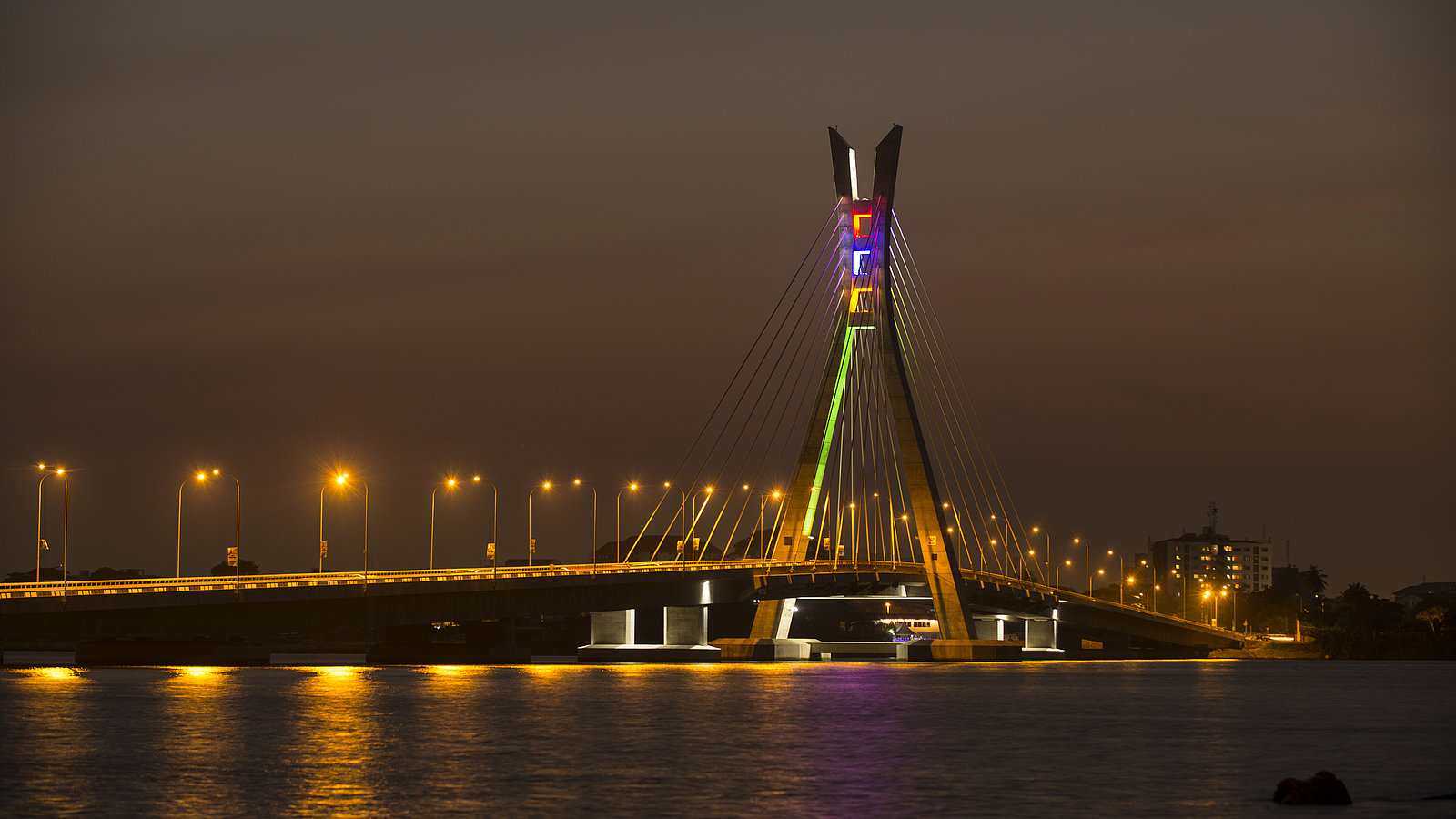
How to reach it: The bridge links Admiralty Way in Lekki Phase 1 with Ikoyi. Cross it as part of a drive or ride-hailing trip between the two districts, or walk it from either end in cooler hours.
Best months: November to February, when evening walks are driest and the harmattan haze sometimes gives the skyline a soft edge. Sunset is the classic time for photographs.
Good to know: The bridge was built as a toll bridge. Tolling was suspended after the protests of 2020, and the position since then is unclear, so check the current arrangement before you cross by car and be ready for cashless payment. Danfo buses, okadas and heavy trucks are not allowed on it.
The honest catch: A bridge is a crossing, not a destination with facilities. There is nowhere to stop a car for photographs, peak hour traffic can erase the time the bridge saves, and a visit is really an add-on to a Lekki or Ikoyi day.
7. Olumo Rock
Olumo Rock is the granite outcrop that gave Abeokuta its name, because Abeokuta means under the rock in Yoruba. The rock rises about 137 metres above the city in the Ikija area, and in the 1800s its caves and tunnels sheltered Egba families during the inter-tribal wars. Guides still lead visitors through the hiding places, past small shrines to the rock’s guardian deity and up to a summit with views across the whole city. A tourist complex at the base adds a museum, craft stalls and lifts for visitors who cannot manage the climb.

How to reach it: Abeokuta is an easy trip from Lagos. The train from Mobolaji Johnson Station at Ebutte Metta takes about two hours, and the road takes about two to three hours depending on traffic. The rock stands near the Itoku adire market in the middle of town.
Best months: November to March, in the dry season, when the rock is not slippery. The Lisabi Festival season, usually in the first months of the year, adds colour to a visit.
Good to know: Entry costs about 1,500 to 3,000 naira. The stairs sit at the lower end of that range and the lift costs more, and fees rose after the site’s recent renovation, so confirm at the gate and carry cash in small notes. The site opens daily, roughly from 9 in the morning to 6 in the evening.
The honest catch: The historic route through the caves is steep, narrow and tight in places, and the lifts have a patchy record, so do not count on them. Guides are knowledgeable and expect a tip on top of the gate fee.
8. Osun-Osogbo Sacred Grove
The Osun-Osogbo Sacred Grove is a forest of about 75 hectares on the edge of Osogbo, wrapped around the bends of the Osun River. UNESCO made it a World Heritage Site in 2005, and it is one of the last patches of primary high forest left in southern Nigeria. The grove is sacred to Osun, the Yoruba goddess of fertility, and its paths link about 40 shrines, two palaces and a remarkable set of monumental sculptures. Many of the sculptures were made from the 1950s onwards, when the Austrian artist Susanne Wenger worked with local artists to rebuild the shrines in a new sacred art style. Mona monkeys greet visitors near the gate.
How to reach it: Osogbo is about four hours by road from Lagos and under two hours from Ibadan. Hire a driver for the day or take an intercity bus to Osogbo, then a local taxi to the grove entrance.
Best months: August, if you want the Osun-Osogbo Festival, a celebration of about twelve days that ends with a procession of devotees in white to the river. November to March brings the same paths in quiet and dry weather.
Good to know: Entry costs about 1,000 to 2,000 naira, with an extra charge for photography, and a guide is provided or available at the gate. Carry cash in small notes. The grove opens daily, roughly from 9 in the morning to 5 in the afternoon.
The honest catch: This is a living place of worship, not a theme park. Follow your guide, keep off the shrines, do not bathe in the river, and accept that some spots cannot be photographed. Upkeep varies, and parts of the grove can look neglected between festivals.
9. Erin Ijesha Waterfalls
Erin Ijesha Waterfall, also called Olumirin, drops down a forested hillside in seven separate levels above the town of Erin Ijesha in Osun State. Olumirin means another god in Yoruba, and tradition says a hunter’s party linked to Akinla, a granddaughter of Oduduwa, found the falls in 1140 AD. Each level has its own pool and character. The first fall is an easy walk and a popular swimming spot, and stone steps climb from level to level for anyone with the legs for it. The seventh level, two to four hours up for most visitors, reaches the top of the hill, where a small village sits near the boundary with Ekiti State.
How to reach it: Drive to Ilesa, then take a local taxi or motorbike taxi the short distance to Erin Ijesha. The whole journey from Lagos takes about three to four hours by road, and the falls pair well with Osogbo on the same trip.
Best months: The falls run fullest at the end of the rainy season, around September and October, but the paths are safest from November to March. A visit just after the rains gives the best balance of water and footing.
Good to know: Entry costs about 500 to 1,000 naira. Local guides wait at the gate and charge about 1,000 to 2,000 naira, and one is worth taking beyond the second level. Wear shoes with grip, carry water, and bring a change of clothes if you plan to swim.
The honest catch: The steps and rocks are slippery, there are no rails on the upper levels, and facilities are basic. Most visitors see two or three levels, and there is no shame in that, because the climb to the seventh is a genuine hike.
10. Idanre Hills
Idanre Hills, or Oke Idanre, rise above Idanre town in Ondo State, and for centuries the town lived up there. The people moved down to the present town in the 1920s, leaving a hilltop of old buildings behind them. UNESCO placed the hills on its tentative list in 2007. The climb runs up about 682 steps, with five resting points, to the old Owa’s Palace, a mud and wood palace dated to the 1600s. Around it stand the old court, shrines, the footprint marked in the rock that tradition links to the hunter Agboogun, and the clear Arun stream, which local belief holds can heal.

How to reach it: Idanre town is about 24 kilometres from Akure, the Ondo State capital. Akure is about four to five hours by road from Lagos, and a local taxi from Akure or Idanre town takes you to the foot of the steps.
Best months: November to March, in the dry season. Start the climb early, because there is little shade on the steps by midday.
Good to know: Entry costs about 1,000 naira for adults and about 500 naira for children, and the site opens daily, roughly from 8 in the morning to 6 in the evening. A local guide costs extra and is close to essential, because the hilltop sites make little sense without the stories. Carry cash, because there is no card machine at the gate.
The honest catch: This is a steep, hot climb followed by ruins, not restored monuments. The old palace is fragile, the paths on top are rough, and anyone with weak knees should think twice. The reward is the view and the strange quiet of an abandoned town in the sky.
Best time to visit Nigeria
For most of this list, the dry season from November to March is the best window. Roads are in their best condition, paths at Erin Ijesha and Idanre are at their safest, and the heat is a little kinder. December to February brings harmattan, a dry wind that carries dust from the Sahara. It cools the mornings in the north, but it can haze over views of Zuma Rock and Aso Rock.
The rainy season runs roughly from April to October in the south. Travel is possible, and Lagos and Abuja sights work in any month, but expect delays on the roads and slippery ground at the outdoor sites. Two dates argue for the rains. The Osun-Osogbo Festival fills Osogbo in July and August, and Erin Ijesha runs at its most dramatic at the end of the rains in September and October.
How to reach Nigeria and getting around
Flights and visas: Lagos and Abuja hold the two main international airports, Murtala Muhammed International and Nnamdi Azikiwe International. Most foreign visitors need a visa arranged before travel, and Nigeria now runs an e-Visa system, so check the current rules on the official immigration website well ahead of your trip. Domestic flights link Lagos and Abuja in about an hour and save a long road day.
Getting around: Ride-hailing apps such as Bolt and Uber work well in Lagos and Abuja. For day trips to Abeokuta, Osogbo or Idanre, hire a known driver, or use the train from Lagos to Abeokuta for Olumo Rock. Travel between cities in daylight, and avoid intercity roads after dark.
Safety: Read this before you plan anything. The United States State Department advisory of June 2026 rates Nigeria at Level 3, Reconsider Travel, for crime, terrorism, unrest and kidnapping, and it places 23 states in full or in part at Level 4, Do Not Travel, including Bauchi, Kaduna, Niger, Borno and Zamfara. The UK Foreign Office advises against all travel to seven states and to the riverine areas of the Niger Delta, and against all but essential travel to many more states, including Niger and Kaduna. Neither list names Lagos, Ogun, Osun or Ondo states, and Abuja city itself is not under a do-not-travel order, but the general warnings on crime and kidnapping apply across the whole country. Two famous sights are missing from this guide on purpose. Yankari National Park in Bauchi State and Kajuru Castle in Kaduna State both sit inside states under do-not-travel advice, and no view is worth travelling against it. Zuma Rock stands just inside Niger State, which is on both warning lists, and its section above carries its own safety note. Check the current advice from your own government before any trip, keep road journeys to daylight, use drivers you know or come recommended, and make sure your travel insurance covers the areas you will visit, because travelling against official advice can void a policy.
FAQs
1. What is the most famous landmark in Nigeria?
Zuma Rock. It stands on the main road out of Abuja, it appears on the 100 naira note, and almost every Nigerian knows its outline. Read its safety note in this guide before you plan a stop there.
2. How many days do you need to see these landmarks?
Allow four to five days for Lagos and the south-west sights, and two more days for Abuja. The ten landmarks split between two regions about an hour apart by air, and no short trip covers all of them well.
3. Is Nigeria safe for tourists?
Parts of it carry serious warnings, and this guide does not hide that. The United States rates the country at Level 3, Reconsider Travel, and 23 states are listed as Do Not Travel. The landmarks in this guide sit outside those states, with the single flagged exception of Zuma Rock just inside Niger State. Check your own government’s current advice before you book anything.
4. What money should you carry?
Carry naira in cash, in small notes, for gate fees, guides and local taxis, because most sites on this list cannot take cards. The exception is the Lekki Conservation Centre, which is cashless and needs a bank card. Cities have ATMs and card payment almost everywhere.
5. Why are Yankari National Park and Kajuru Castle not in this list?
Because of where they stand. Yankari is in Bauchi State and Kajuru Castle is in Kaduna State, and both states are under do-not-travel advice from the United States and all-but-essential advice from the UK. If the official advice changes, both places deserve a section of their own.
6. When is the best month to visit Nigeria?
November to February suits most of this list, with dry roads and safer paths. Come in August instead if the Osun-Osogbo Festival is your reason for travelling, and accept the rain that comes with it.
Researched and verified: November 2026. This guide is research-based, compiled from official travel advice, site information and traveller reports. Prices, hours and security advice change, so confirm them locally before travelling.